This document outlines the general technical standards and sizing guidelines for solar PV systems used in Saudi Arabia, including modules, inverters, batteries, cabling, and charge controllers.
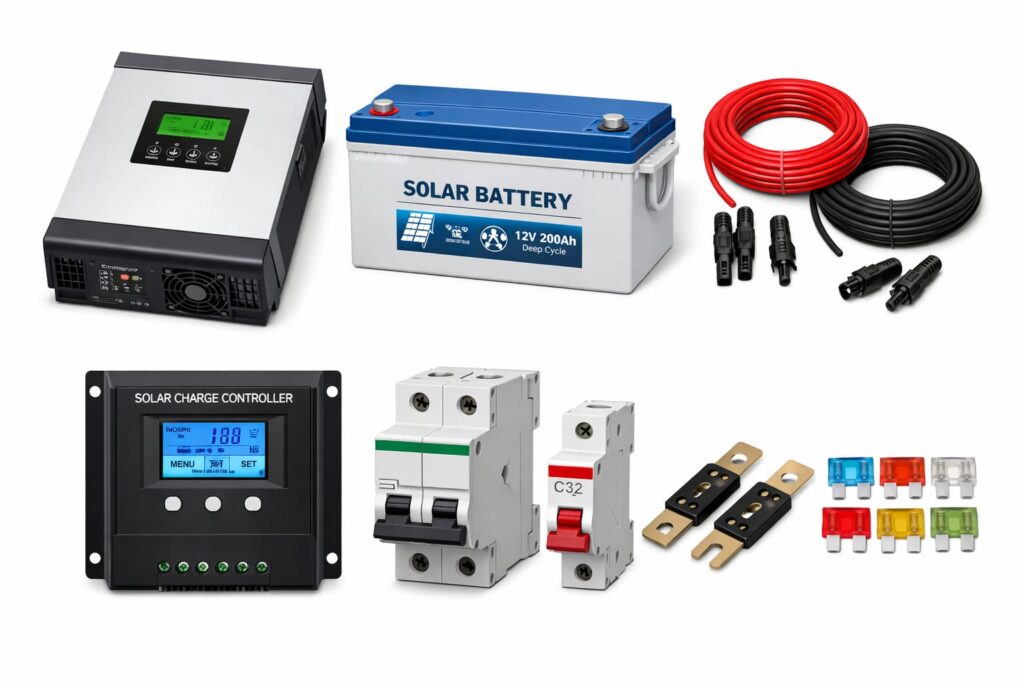
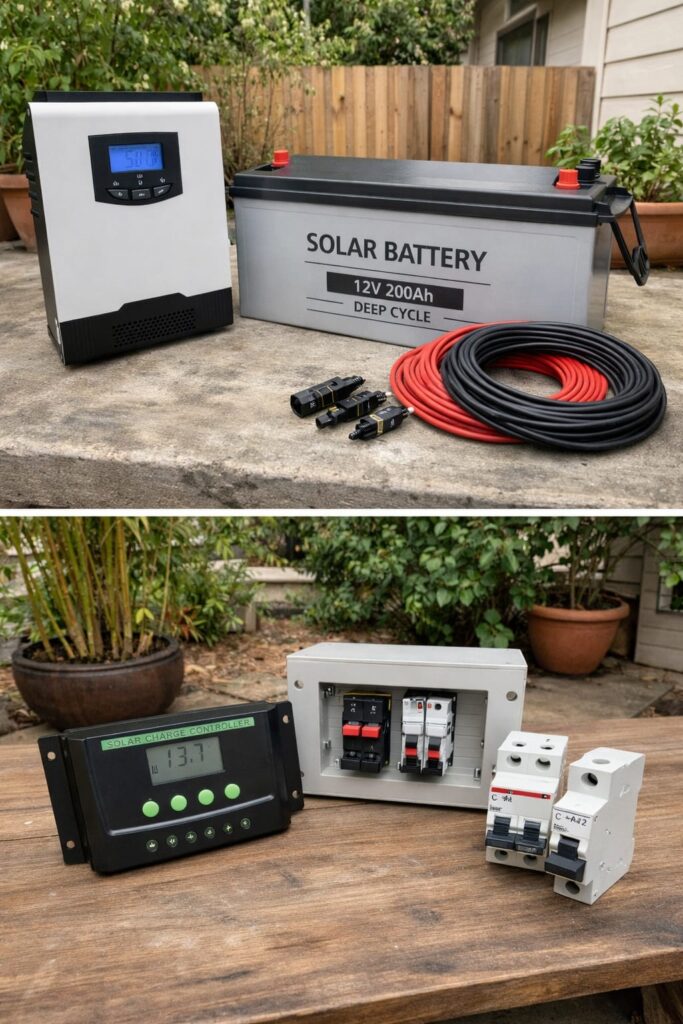
Regulatory Overview
All photovoltaic (PV) modules sold and installed in Saudi Arabia must comply with Saudi Arabian Standards Organization (SASO) technical regulations for solar PV systems.
These regulations cover:
Electrical safety
Performance efficiency
Mechanical load resistance
Environmental durability (heat, dust, humidity)
Modules must include Arabic and English labeling displaying:
Rated power (W)
Voltage (Voc, Vmp)
Current (Isc, Imp)
Manufacturer details
Certification markings
Typical Physical & Electrical Specifications
While Saudi Arabia does not mandate a unique panel dimension, international industry standards are followed.
Common Residential/Commercial Module Characteristics:
Panel size: approximately 1.7 – 2.2 m²
Power rating: 350 W – 620 W per module
High-efficiency modules: around 600 W+
Cell size format: typically 182 mm or similar high-efficiency formats
Typical Electrical Specifications (Example Range)
Power Output: 400 – 620 W
Open Circuit Voltage (Voc): 40 – 55 V
Maximum Power Voltage (Vmp): 30 – 42 V
These values represent modern commercial modules commonly used in Saudi installations.
Function of the Inverter
The inverter converts DC power from solar panels or batteries into AC power for household or grid use.
In Saudi Arabia, grid-connected systems typically operate at:
230 V
50 Hz
Inverter Sizing Guidelines
Inverter capacity depends on:
Total connected load
PV array size
System type (grid-tie, hybrid, off-grid)
Typical Residential Sizes
Small homes: 3 – 5 kW
Medium homes: 5 – 12 kW
Large homes: 10 – 20 kW or more
Inverters are rated for:
Continuous (nominal) power
Peak/Surge power (for motor starting loads)
Battery Types Used in Saudi Arabia
Recommended:
LiFePO4 (Lithium Iron Phosphate)
Longer lifespan
Higher efficiency
Better high-temperature performance
Safer chemistry
Alternative:
Lead-acid (AGM / Gel)
Lower cost
Shorter lifespan
Less efficient
Regulatory Requirements
PV cables installed in Saudi Arabia must:
Comply with Saudi technical regulations
Be UV resistant
Be temperature rated for high heat environments
Follow international electrical safety practices
Cable Sizing Principles
Cables are sized based on:
Current flow
Distance
Allowable voltage drop
Design practice aims to keep voltage drop under 3% on DC circuits.
Typical Cable Sizes (General Practice)DC Cables (Panels to Controller)
4 – 6 mm² copper (small arrays, 20–40 A)
10 – 16 mm² copper (larger arrays)
Battery & Inverter Cables
Because battery current is high, larger cables are required:
16 – 35 mm² or higher depending on system size
Proper insulation and heat resistance are critical in Saudi climate conditions.
We offer flexible service packages designed to suit your schedule:
Daily Cleaning
Weekly Cleaning
Monthly Cleaning
One-Time Deep Cleaning
Move-In / Move-Out CleaningTypes of Charge Controllers
PWM (Pulse Width Modulation)
Lower cost
Suitable for small systems
MPPT (Maximum Power Point Tracking)
Higher efficiency
Better performance in hot and dusty environments
Recommended for Saudi installations
How to Size a Charge Controller
Sizing depends on:
Battery voltage (12 V, 24 V, 48 V)
Total PV array power
Sizing Formula
Controller Current ≥
(PV Power ÷ Battery Voltage) × 1.25